Proper garage door sensor alignment is critical for safety and smooth operation. Sensors use infrared beams, and misalignment prevents the door from closing correctly. Alignment requires correct placement, leveling, and testing with visual indicators. DIY fixes are possible, but professional help ensures reliable, long-term results.
- Garage door sensors use infrared beams to detect obstructions.
- Misalignment causes malfunction and prevents proper closing.
- Place sensors at ankle-to-knee height and ensure exact leveling.
- Secure sensors loosely, then test for proper beam function.
- Call professionals if alignment remains difficult.
Unless you manually pull your door, your garage door sensor is a critical component of your garage door. It is what allows your door to know when it is safe to automatically enable the closing mechanism. And it all works silently and almost invisibly without any involvement needed from you.
That is, unless the sensor alignment becomes misaligned. If you find your garage door sensors are in need of alignment, we’re here to help. Read on in our guide to learn how to align garage door sensors for long-term reliability.
How Garage Door Sensors Work
Before we dive into the troubleshooting portion of our guide, let’s first talk about the sensors themselves.
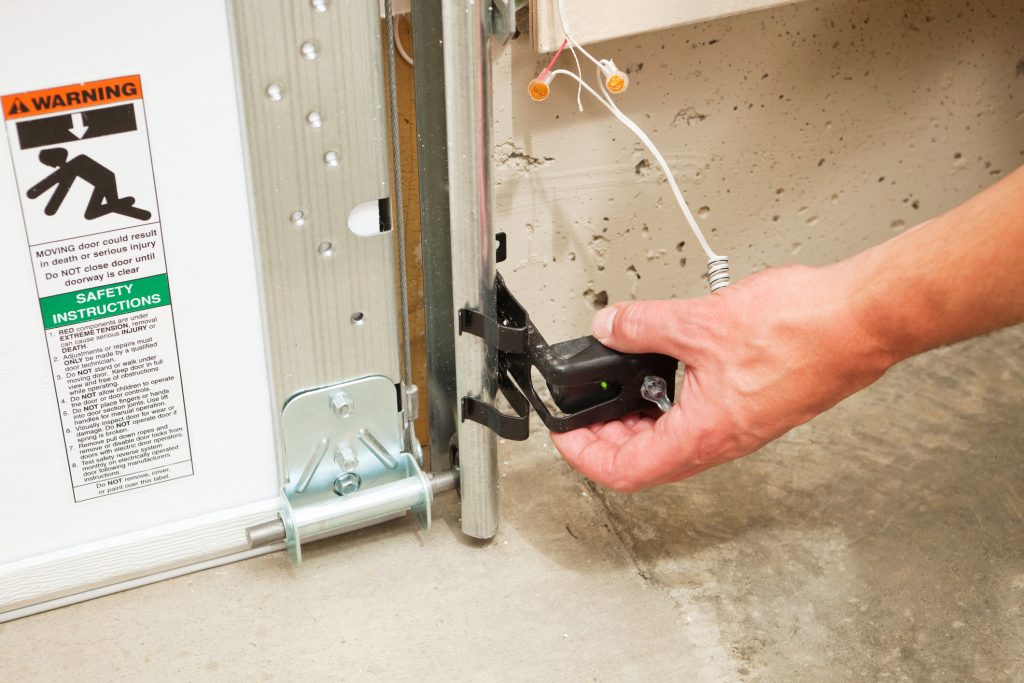
Your garage door comes equipped with two components that don’t actually affix to the door itself. They, instead, affix to your garage wall or to your garage door’s metal track. These two components form the sensor array that communicates with the door and allows it to operate.
A sensor uses an infrared beam being sent from a transmitting emitter and being captured by an infrared detector. The beam, when unbroken, gives the garage door opener the go-ahead when operating. If the beam is broken, such as when you step through it, the sensor system tells your garage door to halt operations temporarily.
If you’d like to learn more about the inner workings of sensor equipment, we recommend this video.
The Importance of Alignment
With your garage door sensors, alignment is everything. The beam must be sent in a straight path from the transmitter to the detector. A failure for the beam to squarely reach the detector means misaligned garage door sensors. And this will only mean your door will fail to operate properly.
How to Achieve Aligned Sensors
Start by turning the power off to your sensors before deciding the optimal placement. Many homeowners select the metal track for their garage door.
For height, a garage door sensor must be placed high enough that you would break the beam when stepping through it. We recommend ankle-to-knee height for these purposes. Any lower and simple rocks or even insects could break the beam. Any higher and pets and other animals may not be able to break it.
The trick is you need the exact same height for both sensor components. To achieve this, we recommend a tape measure, laser level, or other tool to ensure aligned placement. Some homeowners also enjoy low-tech methods, such as a string tied from one sensor to the other to eyeball the level.
Next, once eyeballed affix your sensors to their housing via their bracket screws. Be sure not to tighten too much at this stage, as you may need to adjust during the next step. The screws should be tight enough, however, to ensure the sensors don’t slide or move during this step.
Once fairly secure, turn the power back on and visually inspect the sensors. This will reset the garage door sensor.
There should be an LED light or other visual indicator that they are powered on and working. Generally speaking, regardless of model or maker, a steady light means they are working and ready. Meanwhile, a blinking light typically means the beam has been broken.
The next step involves testing your hardware. Start by running a hand between the sensors where you imagine the beam to be. If you see a blinking light on either unit when passing your hand between, that means you have successfully broken the beam.
If you do not see an indication of a broken beam, this means you have misaligned garage door sensors. Try adjusting the alignment and reset the garage door sensors again.
Next, try closing or opening your garage door. As it moves, try breaking the beam again. If the garage door suddenly stops moving, that means you have a properly functioning garage door alignment!
Call the Pros When Needed
Garage door sensor alignment is an important component of a functioning garage door. But in some cases it may seem impossible to achieve. Thankfully, help is available.
If you are struggling to achieve the perfect balance needed between your garage door sensors, Hilton Head Garage Doors can help. Our trained and expert team are adept at garage door maintenance, installation, and anything else you might need. And we work efficiently to ensure your garage is back up and running quickly.
We know not every homeowner is a confident DIYer. Adjusting garage door sensors may not be for everyone. For us, though, us it’s one of the many maintenance and service tasks we’re proud to provide to South Carolina’s Lowcountry.
If you are in need of garage door alignment, we are here to serve you. Learn more about our garage door repair services here.